Military Vehicle Spare Parts: A Complete Guide To Selection, Quality, And Procurement
Learn how to select military vehicle spare parts through NSN verification, platform compatibility, quality control, supplier evaluation, and custom manufacturing.
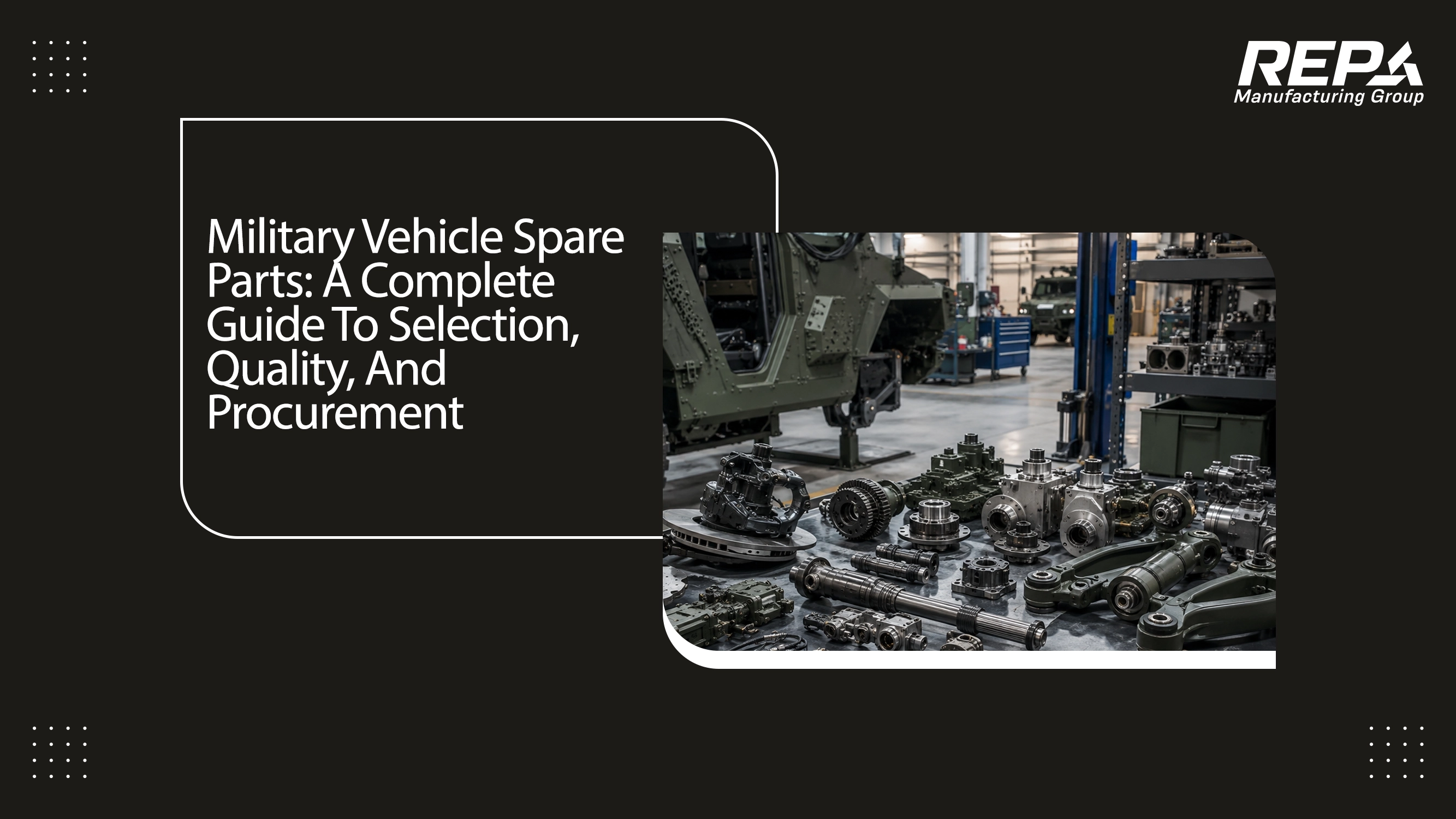
Military vehicle spare parts include the mechanical, hydraulic, pneumatic, electrical, and electromechanical components used in the maintenance, repair, modernization, and operational support of defense vehicles.
Selecting the correct component is not only necessary to return a vehicle to service. A technically compliant spare part also affects vehicle reliability, maintenance duration, mission readiness, safety, and total lifecycle cost.
Military vehicle components may operate under heavy loads, vibration, impact, extreme temperatures, moisture, dust, mud, and long storage periods. A part that is suitable for a standard commercial vehicle may not necessarily meet the operating requirements of a military platform.
Products in the REPA Manufacturing Group military vehicle spare parts catalog can be reviewed according to vehicle platform, product name, NSN, and cross-reference number.
This guide explains the main military vehicle spare part categories, product identification methods, quality requirements, supplier evaluation criteria, custom manufacturing options, and RFQ processes.
What Are Military Vehicle Spare Parts?
Military vehicle spare parts are components used to replace items that have failed, worn out, reached a scheduled maintenance interval, or require replacement during modernization.
These components may be used in:
A component is not suitable for a military platform simply because it fits into the installation location. It must also meet the technical, functional, environmental, and operational requirements of the intended vehicle.
Military vehicle spare parts are generally procured for:
Main Military Vehicle Spare Part Categories
Military vehicles consist of multiple interconnected systems. Each system has different operating conditions and quality requirements.
Brake System Components
Brake system components enable a vehicle to slow down and stop in a controlled manner.
This category may include:
Important characteristics include friction material, thermal resistance, wear behavior, attachment quality, surface contact, and dimensional conformity.
The M60 A3 brake band and lining assembly in the REPA catalog is an example of a military vehicle brake component identified through an NSN and cross-reference numbers.
Suspension and Steering Components
Suspension and steering components affect vehicle control, stability, mobility, and load transfer.
Material strength, fatigue resistance, hole geometry, connection angles, forging or welding quality, and surface protection should be evaluated.
The HUMMER HMMWV and OTOKAR COBRA product category includes left and right suspension control arms and other platform-specific components.
Transmission and Power-Transfer Components
Transmission and power-transfer components transmit engine power to the drivetrain and other moving systems.
This category may include:
Torque-transfer capacity, material grade, heat treatment, balance, axial alignment, dimensional accuracy, and fatigue resistance are important characteristics.
The M109 and M110 flexible shaft coupling is an example of a power-transfer component identified by both an NSN and a manufacturer reference.
Central Tire Inflation System Components
Central tire inflation systems support the adjustment and maintenance of tire pressure under different terrain and load conditions.
The main components may include:
Pressure resistance, sealing performance, corrosion resistance, dimensional compatibility, and elastomer suitability should be verified.
The REPA catalog includes central tire inflation system lock valves identified by NSN and cross-reference numbers.
Engine, Exhaust, and Cooling Components
Engine-support systems include air, fuel, cooling, exhaust, and control components.
Operating temperature, vibration resistance, corrosion resistance, dimensional compatibility, and environmental performance should be considered.
Electrical and Electromechanical Components
Military vehicles use electrical components for starting, charging, signaling, lighting, and system control.
Voltage, current capacity, connector geometry, insulation, vibration resistance, and environmental protection should be verified.
Examples can be reviewed through REPA’s all products catalog.
Recovery, Towing, and Support Equipment
Equipment used for recovery, towing, transportation, and maintenance may also form part of a military vehicle spare parts portfolio.
This category may include:
Safe working load, connection geometry, material strength, and deformation resistance are important evaluation criteria.
Why Is Platform Compatibility Important?
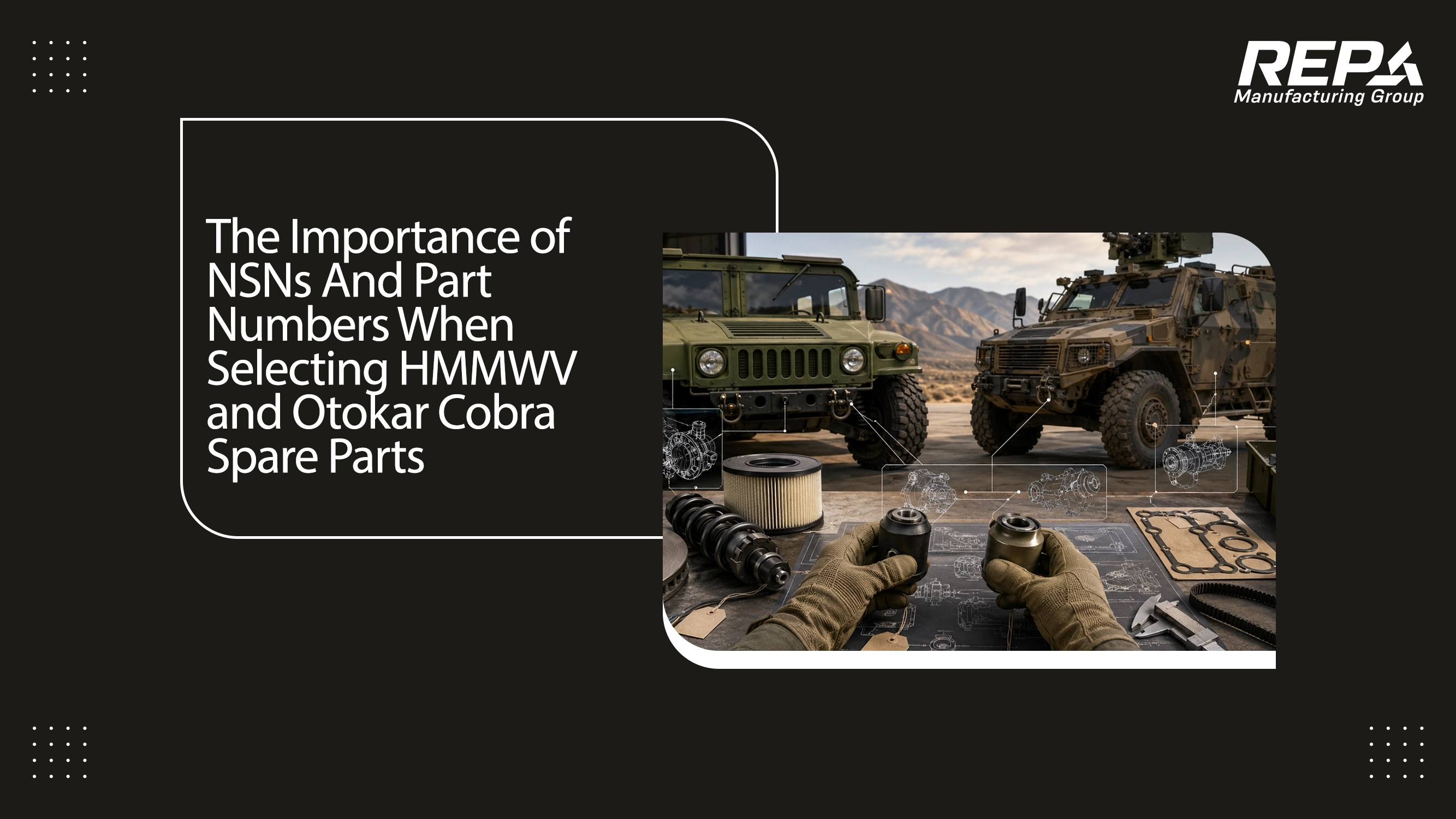
Components described by the same general product name may have different dimensions and technical characteristics on different vehicle models.
For example, the use of a “suspension arm” on two platforms does not mean that the components are interchangeable. Connection geometry, material, load capacity, axis angles, and mounting dimensions may differ.
The following platform information should be verified:
The REPA product portfolio can be reviewed according to the following vehicle families:
Using platform information together with the NSN and manufacturer part number helps reduce the risk of incorrect product selection.
How Are NSNs and Part Numbers Used?
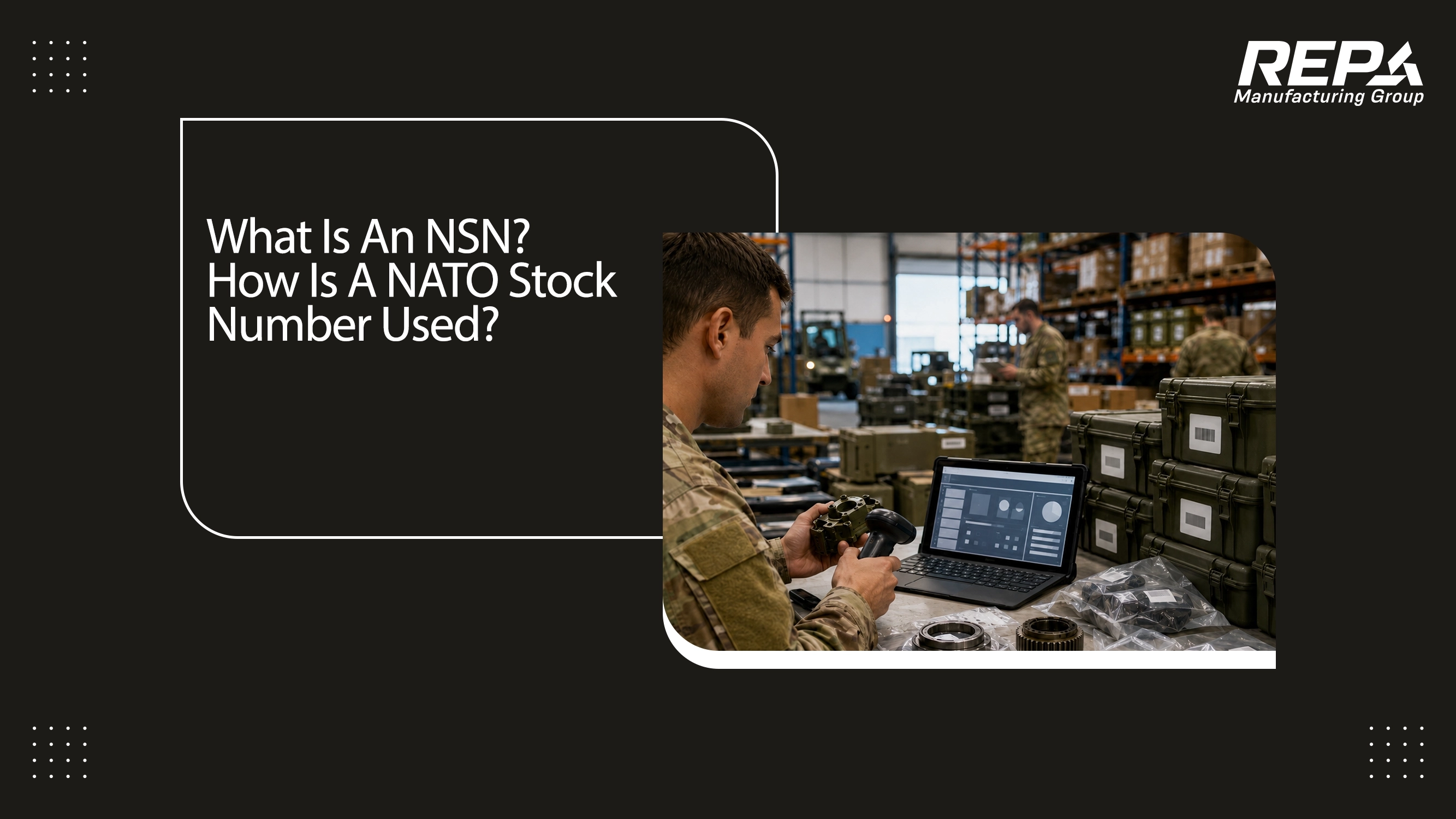
One of the most important product-identification tools in military vehicle spare parts procurement is the NSN.
An NSN provides a standardized reference for a specific supply item. However, an NSN and a manufacturer part number are not the same.
An NSN identifies an item within a standardized supply codification system.
A manufacturer part number is a technical or commercial reference assigned by the manufacturer.
The following information should be used together whenever possible:
A single incorrect digit may result in an unrelated component being researched, quoted, or manufactured.
NSNs and part numbers should therefore be verified before the RFQ is issued.
Quality Criteria for Military Vehicle Spare Parts
A professional surface finish alone does not prove that a component is technically compliant.
The following factors should be evaluated together.
Correct material
Material selection affects strength, hardness, wear resistance, fatigue life, corrosion resistance, and overall service life.
Depending on the component, the supplier may be required to provide:
Dimensional and tolerance conformity
The component must comply with the dimensions and tolerances required for assembly and operation.
Characteristics that may require inspection include:
Coordinate measuring machines, special gauges, and dedicated fixtures may be required for complex geometries.
Controlled manufacturing processes
Producing one acceptable component is not sufficient. The same quality level should be maintained across different production batches.
The manufacturer should control:
Functional verification
A component may meet its dimensional requirements but still fail to perform its intended function.
Depending on the product, applicable tests may include:
Traceability
A high-quality product should be linked, whenever required, to its raw material, production batch, inspection records, and test results.
Traceability can help identify:
How Should a Military Spare Parts Supplier Be Selected?
Supplier selection is as important as product selection.
A military spare parts supplier should be evaluated according to:
The evaluation should not focus only on the number of available machines. The supplier must also have the required precision, inspection, testing, process-control, and documentation capabilities.
REPA Manufacturing Group’s production and inspection infrastructure can be reviewed on the machinery park page.
Quality management documentation can be reviewed on the certificates page.
Are Certifications Sufficient on Their Own?
Quality management certifications provide evidence that a manufacturer manages its activities through defined and controlled processes.
However, certification does not automatically prove that every individual component complies with its technical requirements.
The following certificate details should be checked:
For each product, material certificates, dimensional reports, test records, and traceability documentation may still be required.
Is Procurement Different for Legacy and Modern Vehicles?
Modern platforms may have more accessible technical drawings, bills of materials, and manufacturer support.
Legacy platforms may create challenges such as:
Alternative manufacturing, redevelopment, and reverse-engineering options may be considered when standard supply channels are unavailable.
How Can Unlisted Components Be Manufactured?
When a product is not available in the standard catalog, its manufacturability may be evaluated using a technical drawing, physical sample, dimensional data, or NSN.
A used sample may be worn, corroded, repaired, or deformed. Reverse engineering should therefore consider not only the existing dimensions but also the component’s function and relationship with adjacent systems.
REPA Manufacturing Group’s custom manufacturing capability supports product assessments based on samples and technical data.
What Information Should Be Included in an RFQ?
A complete RFQ reduces technical uncertainty and supports more accurate pricing.
A military vehicle spare parts RFQ should include:
When no technical drawing is available, the customer may provide product photographs, a physical sample, installation information, and existing dimensions.
Technical and commercial requests can be submitted through the REPA Manufacturing Group contact page.
International Military Vehicle Spare Parts Procurement
When military vehicle spare parts are sourced internationally, foreign trade and logistics requirements must be evaluated alongside technical requirements.
Authorization and documentation requirements may vary according to the product, origin, destination, end user, and intended use. Each project should therefore be evaluated individually.
Why Are Packaging and Storage Important?
A conforming component can be damaged during transportation or storage because of unsuitable packaging.
Depending on the product, suitable protection methods may include:
The part number, NSN, quantity, and batch information shown on the package should match the shipment and quality documents.
Common Military Vehicle Spare Parts Procurement Mistakes
Ordering only by product name
General product names may not distinguish between different platforms, configurations, and revisions.
Confusing an NSN with a manufacturer part number
NSNs and manufacturer part numbers are different identification systems. Both should be provided whenever available.
Using an obsolete drawing revision
Manufacturing according to an outdated revision may cause assembly or functional problems.
Selecting the lowest price without technical evaluation
A lower price may result from excluded documentation, unsuitable materials, limited testing, or inadequate process control.
Skipping first article verification
First article inspection reduces risk for newly developed products and components procured from a new supplier.
Failing to specify packaging requirements
Sensitive surfaces and metal components may be damaged during shipment when packaging requirements are not defined.
Failing to require traceability
Without batch information, identifying the affected product group may be difficult when a nonconformity occurs.
Military Vehicle Spare Parts from REPA Manufacturing Group
REPA Manufacturing Group manufactures spare parts identified through NSNs and cross-reference numbers for military vehicles and defense systems.
The product portfolio can be reviewed through:
For components that are unavailable through standard supply channels, custom manufacturing options may be evaluated using technical drawings, physical samples, dimensional information, and existing part references.
Frequently Asked Questions
What are military vehicle spare parts?
Military vehicle spare parts are mechanical, electrical, hydraulic, pneumatic, and electromechanical components used for the maintenance, repair, modernization, and operational support of defense vehicles.
What is the most important information when selecting a military vehicle part?
No single reference is always sufficient. The NSN, manufacturer part number, platform, technical drawing, and revision should be evaluated together.
Does an NSN guarantee product quality?
No. An NSN supports standardized product identification. Material, manufacturing quality, dimensions, tolerances, and test results must be verified separately.
Can one component be used on multiple military vehicles?
Certain common components may be used on more than one platform. Technical and installation compatibility must be verified before procurement.
Can a part be manufactured without a technical drawing?
Reverse-engineering and manufacturability assessments may be possible when a physical sample, dimensions, material information, and operating data are available.
How should a military spare parts supplier be selected?
Manufacturing infrastructure, similar-product experience, inspection capability, quality systems, traceability, documentation, technical communication, and delivery performance should be evaluated together.
What information is required to request a quotation?
The NSN, part number, product name, platform, quantity, technical drawing, delivery location, and required quality documentation should be provided whenever available.
Is a quality certificate sufficient?
A certificate is an important supplier qualification indicator, but individual product conformity should also be verified through material, inspection, testing, and production records.
Can a quotation be requested for a component that is not listed in the catalog?
Yes. A technical evaluation may be performed when a technical drawing, physical sample, dimensional information, or existing product reference is available.
Military vehicle spare parts procurement involves more than finding a product with the correct general name.
A reliable procurement process requires coordinated management of:
Correctly selected military vehicle spare parts manufactured through controlled processes can help reduce maintenance delays, support vehicle reliability, and extend the operational life of defense platforms.
By providing the NSN, manufacturer part number, vehicle platform, technical drawing, and required quantity, customers can request an evaluation of manufacturability, lead time, and quality-documentation requirements.
For military vehicle spare parts requirements, contact REPA Manufacturing Group.