Spare Parts Procurement Processes In International Defense Projects
Learn how spare parts procurement is managed in international defense projects, from technical verification and supplier qualification to export compliance, quality control, and logistics.
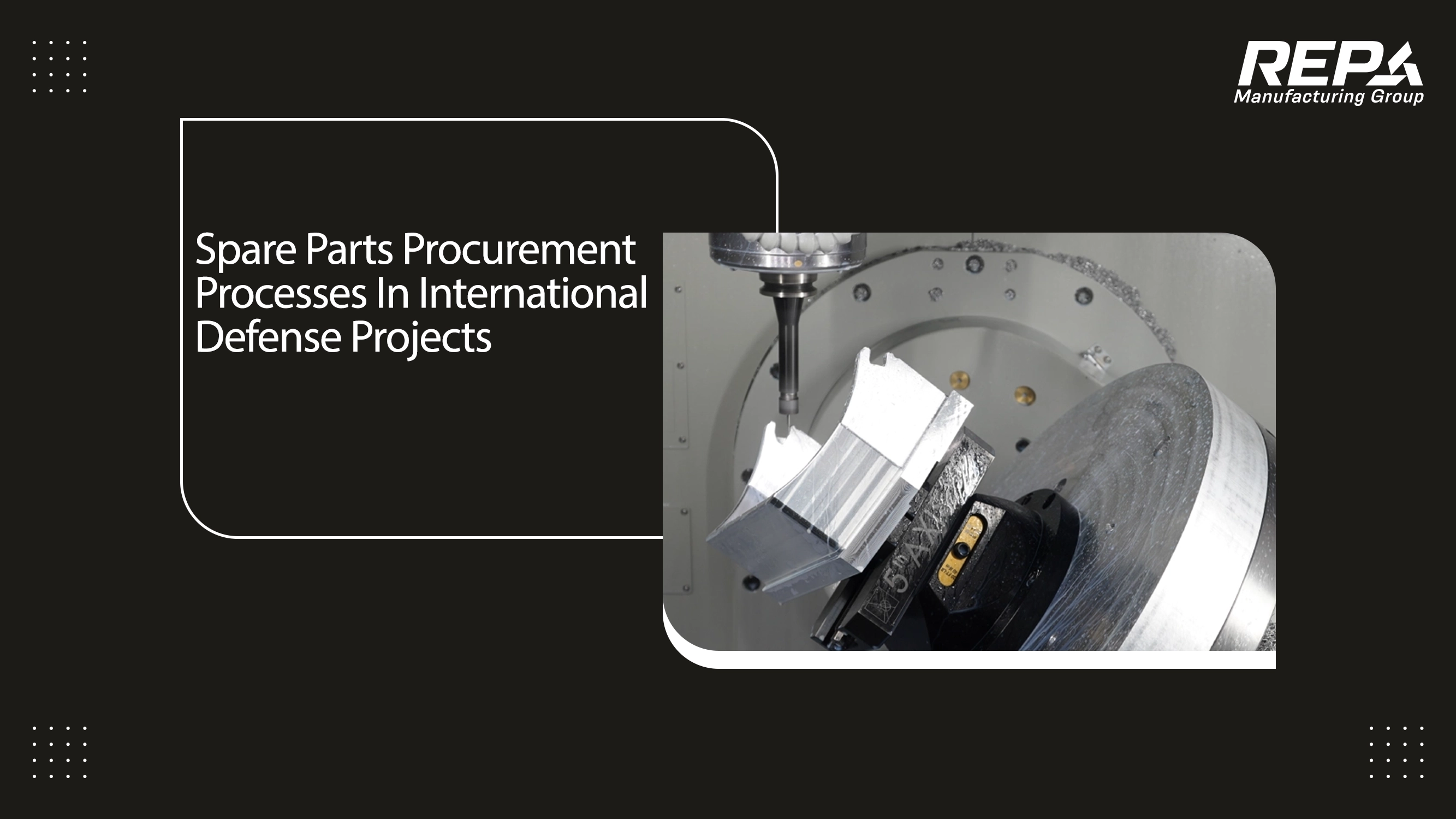
Spare parts procurement in international defense projects is more complex than a standard commercial purchasing transaction. Finding and pricing the required component is not sufficient on its own. The product must be verified for the correct platform, manufactured in accordance with technical requirements, supplied with the required quality documentation, and shipped in compliance with the foreign trade procedures of the countries involved.
Military vehicles and weapon systems may remain in service for several decades. During this period, procurement teams may encounter manufacturer changes, technical revisions, updated part numbers, obsolete components, and discontinued production.
For this reason, international defense spare parts procurement requires coordinated work among purchasing, engineering, quality, manufacturing, export compliance, customs, and logistics teams.
The military vehicle spare parts and weapon spare parts catalogs of REPA Manufacturing Group allow products to be reviewed by platform, product name, NSN, and cross-reference number.
So, what stages are involved in an international defense spare parts procurement process, and how can project risks be reduced?
What Is International Defense Spare Parts Procurement?
International defense spare parts procurement is the process of obtaining components used in military vehicles, weapon systems, maintenance equipment, or defense platforms from a manufacturer or supplier located in another country.
This process extends beyond the purchase of the physical product. The supply chain may include:
An error or omission at any of these stages may result in the procurement of an incorrect item, delivery delays, customs holds, quality nonconformities, or incompatibility with the intended system.
Why Is Procurement More Complex in International Defense Projects?
Parts procured for defense projects are often used in operationally critical systems. Their technical conformity and traceability must therefore be evaluated before price alone.
The main factors that increase procurement complexity include:
For older military platforms, the original manufacturer may no longer be operating, or serial production of the part may have ended. In these situations, reproduction based on technical drawings, physical samples, or existing product data may be evaluated.
Through REPA Manufacturing Group’s custom manufacturing capabilities, component manufacturability can be assessed using a technical drawing, physical sample, dimensions, or NSN information.
1. Defining the Requirement Correctly
The first step in a successful procurement process is to define the requirement clearly and in a verifiable format.
General product descriptions such as “brake lining,” “shaft coupling,” “suspension arm,” or “valve” may not be sufficient for an international RFQ. Components described by the same name may have different dimensions, materials, configurations, or platform-specific versions.
The requirement should include as much of the following information as possible:
Identifying the platform in which the product will be used helps distinguish similar references and reduces the risk of incorrect product selection.
The platform-specific sections of the REPA product portfolio include:
2. Verifying the NSN, Part Number, and Cross-References
One of the most important tools for identifying products in international defense procurement is the NSN.
An NSN is a standardized 13-digit number used to identify a supply item within NATO or an associated national codification system. The NATO Codification System supports the management of supply items through common references across different countries and suppliers.
An NSN may not always be sufficient on its own. The following information should be reviewed together:
For example, the M109 and M110 flexible shaft coupling in the REPA catalog is identified by the 3010-00-432-7236 NSN and the 11662761 part number.
Similarly, the M60 A3 brake band and lining assembly can be verified through its NSN and cross-reference numbers.
A single incorrect digit in an NSN or part number may result in the wrong product being quoted or manufactured. Technical verification should therefore be completed before the quotation is finalized.
3. Preparing the Technical Data Package
The technical data package is the group of documents that enables the supplier to understand, quote, manufacture, inspect, and deliver the product correctly.
A well-prepared technical data package may include:
The part number and revision stated in the purchase documents must match the technical drawing.
Using an obsolete drawing revision may result in a component that is incompatible with the current system configuration. The validity of all technical documents should therefore be checked before issuing the RFQ.
When technical data is unavailable, a physical sample may be used for dimensional inspection and manufacturability analysis. However, wear, deformation, corrosion, and previous repairs must be considered. The dimensions of a used component may not represent the original design dimensions.
4. Confidentiality and Technical Data Security
Technical drawings, product information, and system data used in international defense projects may be commercially or operationally sensitive.
Before technical information is shared, the following matters should be defined:
Technical information should be shared only with authorized personnel who require it for the project.
The supplier’s document-control system, revision-management process, access controls, and customer-data protection practices should also be evaluated.
5. Supplier Prequalification
Not every manufacturer can produce every defense component to the same technical and quality level. Supplier capability should therefore be evaluated before price quotations are compared.
Supplier prequalification criteria may include:
REPA Manufacturing Group’s production and measurement infrastructure can be reviewed on the machine park page.
Quality management systems and corporate documentation can be reviewed on the certificates page.
The existence of a certificate is an important indicator, but the supplier’s technical competence for the specific component or product group should also be confirmed.
6. Evaluating Export, Import, and End-User Compliance
Defense products and certain associated technical components may be subject to special foreign trade requirements depending on the product classification, country of origin, destination, end user, and intended use.
The following questions should be addressed before a quotation or order is accepted:
Some transactions may require documents concerning the end user, end use, or re-export restrictions.
Because licensing requirements vary according to the legal and technical classification of the product, each project should be evaluated under the applicable laws and authority requirements.
Export compliance should not be postponed until the shipment stage. The expected authorization period should be incorporated into the quotation lead time and project schedule from the beginning.
7. Preparing the Request for Quotation
An international RFQ should clearly define both technical and commercial expectations.
The RFQ should generally include:
General statements such as “manufacture in accordance with the specification” may not be sufficient. The inspections, reports, and documents that must be included in the supplier’s quotation should be listed explicitly.
The required documentation may include:
8. Evaluating Technical and Commercial Quotations
Quotations for international defense projects should not be compared solely on unit price.
A lower-priced quotation may exclude inspection documentation, testing, packaging, insurance, export procedures, or special tooling. As a result, its total project cost may ultimately be higher.
The following criteria should be evaluated together:
Total cost of ownership extends beyond the purchase price. Indirect costs such as assembly incompatibility, early failure, replacement shipment, inventory delays, and operational downtime should also be considered.
9. Defining Contract and Delivery Conditions
After the technical scope is approved, the responsibilities of the parties should be clearly defined in the contract.
For international deliveries, Incoterms® 2020 rules may be used to define the responsibilities of the buyer and seller regarding transportation, costs, risk transfer, insurance, export procedures, and import procedures.
However, stating only “FCA,” “CIP,” “DAP,” or another Incoterms® rule is not sufficient. The named place or delivery point should also be clearly specified.
FCA Ankara, Türkiye – Incoterms® 2020
Without a named place, disagreements may arise regarding the point at which risk and costs are transferred.
10. First Article and Prototype Verification
First article verification is particularly important for newly developed parts, reverse-engineered components, or products being procured from a new supplier for the first time.
The first article process may include:
First article approval is not limited to the physical component. The material, process, tooling, fixtures, inspection methods, and documentation intended for serial production should also be verified.
When the manufacturing process or material is changed after first article approval, the customer should be informed and reapproval may be required.
For components that are not listed in the catalog and must be developed from a sample or technical drawing, the custom manufacturing capabilities page can be reviewed.
11. Production Planning and Raw Material Management
After the order is approved, the operation sequence, raw materials, production equipment, subcontracted processes, and quality-control stages must be planned.
The production plan may include:
Long-lead raw materials or special processes may directly affect the project schedule. Critical material lead times should therefore be evaluated during the quotation stage.
For operations such as heat treatment, coating, and external testing, approved subcontractors should be used and process documentation should be retained.
12. Quality Control and Product Documentation
In international defense projects, product conformity should be supported by documented inspection and test results.
The inspection scope may vary according to the function and risk level of the component.
Applicable controls may include:
The quality documentation package may include:
Documentation requirements should be defined before production begins. Certain records cannot be created retrospectively if the relevant data was not collected during production.
13. Product Traceability
Traceability allows the manufacturing and supply history of a product to be followed from raw material to shipment.
An effective traceability system should connect the following information:
When a nonconformity is identified, traceability makes it easier to determine which batch, serial number, or shipment is affected.
Without traceability, a problem affecting a limited number of parts may need to be treated as though it affects an entire inventory group.
14. Packaging, Marking, and Preservation
During international transportation, products may be exposed to moisture, impact, vibration, temperature fluctuations, and corrosion.
Packaging should therefore be selected according to product characteristics, storage duration, transportation method, and environmental conditions.
Protection methods may include:
Product labels may include:
The information on the labels should be consistent with the product, shipping documents, packing list, and quality records.
15. International Transportation and Customs Procedures
The classification, dimensions, weight, value, sensitivity, and security requirements of defense spare parts must be considered when selecting a transportation method.
Common transportation options include:
The following criteria should be evaluated:
Before shipment, the commercial invoice, packing list, transport document, certificate of origin, quality documentation, and applicable permits should be reviewed.
The product description, quantity, weight, country information, and customs tariff code shown on each document should be consistent.
16. Incoming Inspection and Product Acceptance
When the goods arrive in the destination country, checking only the number of packages is not sufficient.
The incoming inspection process may include:
When damage, missing quantities, or documentation discrepancies are identified, photographs, inspection records, and transport claims should be prepared promptly.
Defining acceptance criteria before the order is placed allows the responsibilities of the parties to be assessed more efficiently when a nonconformity occurs.
17. Nonconformity and Corrective Action Management
When a product does not meet the technical requirements, returning it may not be sufficient. The root cause of the nonconformity should be identified, and corrective measures should be implemented to prevent recurrence.
The nonconformity process may include:
Traceability and inspection records make it easier to determine whether the issue affects one item, one batch, or the entire production lot.
18. After-Sales Support and Lifecycle Management
Defense platforms remain operational for long periods, so supplier relationships should not be viewed as one-time transactions.
After-sales support may include:
For frequently used critical components, minimum stock levels, reorder points, and estimated annual consumption may be established.
This approach reduces operational risks caused by long manufacturing and international transportation lead times.
Main Risks in International Procurement
Risks in international defense projects may arise at any stage of the procurement process.
Technical identification risk
An incorrect NSN, part number, drawing, or revision may result in the wrong component being manufactured.
Supplier capability risk
A supplier may lack the required material, manufacturing, measurement, testing, or quality infrastructure.
Regulatory risk
Missing export, import, transit, or end-user documentation may delay or prevent shipment.
Lead-time risk
Unrealistic planning of raw material, special process, production, licensing, and transportation periods may affect the overall project schedule.
Logistics risk
Incorrect packaging, an unsuitable carrier, or problematic transit points may result in damage or delay.
Documentation risk
Missing material, inspection, testing, or conformity documents may prevent product acceptance.
Currency and cost risk
Foreign exchange movements, energy costs, and raw material price changes may affect long-term quotations.
Single-source dependency risk
Depending on a single manufacturer, supplier, or country for critical components may reduce supply-chain resilience.
How Can Procurement Risks Be Reduced?
The following practices may be used to reduce risk:
International RFQ Checklist
The following checklist may be used before an RFQ is sent to the supplier.
Technical information
Commercial information
Quality and documentation
Foreign trade information
International Spare Parts Procurement with REPA Manufacturing Group
REPA Manufacturing Group manufactures spare parts identified through NSNs and cross-reference numbers for military vehicles and various weapon systems.
The product portfolio can be reviewed through the following categories:
For obsolete or unlisted components, manufacturability assessments may be performed using technical drawings, physical samples, dimensional data, or NSN information.
For more information about the production and measurement infrastructure, visit the machine park page. Quality management documentation can be reviewed on the certificates page.
Providing the following information with an RFQ can accelerate the technical and commercial evaluation process:
Technical and commercial evaluation requests can be submitted through the REPA Manufacturing Group contact page.
Frequently Asked Questions
How long does international defense spare parts procurement take?
The lead time depends on stock availability, raw material procurement, manufacturing method, first article requirements, quality documentation, export authorizations, and transportation method. Manufacturing, licensing, and logistics lead times should be evaluated separately during the quotation stage.
Is an NSN sufficient for international procurement?
An NSN simplifies product identification, but the part number, platform, technical drawing, revision, and required quantity should also be provided whenever available.
Can a part without a technical drawing be manufactured for an international project?
When a physical sample, dimensions, material information, and operating conditions are available, manufacturability and reverse-engineering studies may be performed. The sample and system information should be evaluated together to identify critical characteristics.
Why is first article inspection important?
First article inspection confirms dimensional, material, assembly, and functional conformity before serial production. It reduces risk when working with a new supplier or a newly developed component.
Which quality documents should be requested?
The documentation scope depends on the product’s criticality and technical specification. Documents may include a certificate of conformity, material certificate, dimensional inspection report, test report, heat-treatment certificate, and coating certificate.
Why are Incoterms® important?
Incoterms® rules help define who organizes transportation, which costs are assigned to each party, and where the risk of loss or damage transfers from the seller to the buyer. The selected rule should always include a clearly named place.
Is an export license required for every defense spare part?
Authorization requirements vary according to product classification, technical characteristics, origin, destination country, end user, and intended use. Every product and project must be evaluated under the applicable regulations.
Should the lowest-priced quotation be selected?
Quotations should not be assessed only by unit price. Technical conformity, documentation, manufacturing time, transportation, insurance, customs, warranty, and total lifecycle cost should also be considered.
Which documents are required for an international shipment?
Requirements vary by product and destination country. The shipment file may include a commercial invoice, packing list, transport document, certificate of origin, quality documentation, and applicable export or import authorizations.
Spare parts procurement in international defense projects requires coordinated management of technical, quality, regulatory, commercial, and logistical processes.
A successful procurement process depends on:
Successful international defense procurement requires the correct product, the correct documentation, and the correct delivery plan to be managed together. This approach reduces technical incompatibility, project delay, and total cost risks.
By sharing the NSN, part number, technical drawing, quantity, and destination country of the military vehicle or weapon-system component you require, you can request an evaluation of available manufacturing and procurement options.
For international defense spare parts requirements, contact REPA Manufacturing Group.